
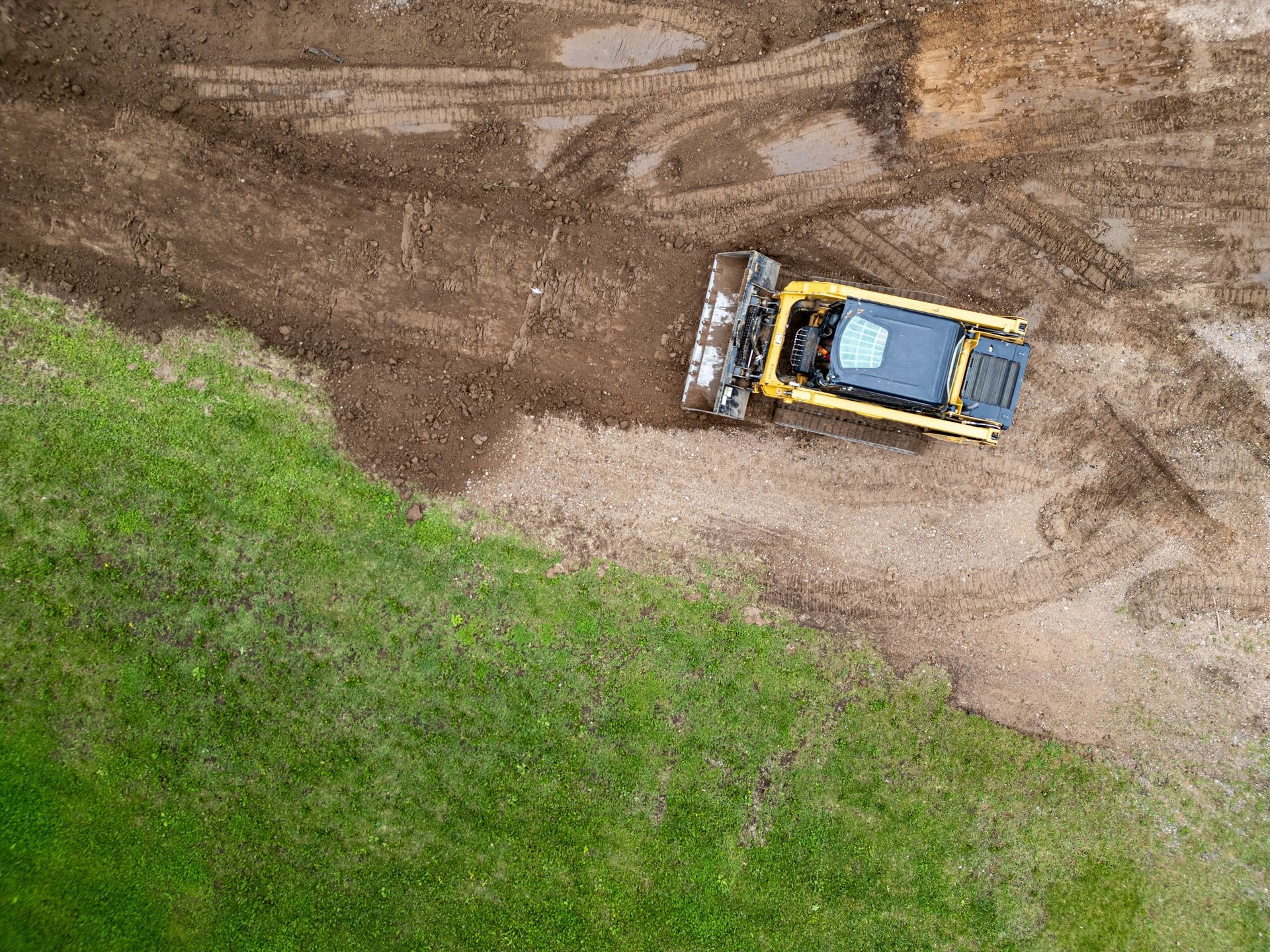
Slope and Drainage Problems Fixed at Ground Level
Grading in Charlotte for properties where water flow, uneven terrain, or poor slope is preventing proper drainage or site preparation
The process of correcting a property's grade starts with reading how water currently moves across the surface—where it pools, where it runs toward structures instead of away from them, and where existing high and low points create conditions that make construction, landscaping, or functional yard use difficult. Oakhurst Landscaping and Tree Service performs grading in Charlotte by first establishing a grading plan based on those findings, then bringing in equipment to cut and fill as needed, compacting the reworked soil to a stable, properly sloped surface. The work addresses the underlying flow problem rather than masking it with surface drainage alone.
Properties in areas like Concord and Huntersville—where residential development has expanded rapidly onto terrain that wasn't originally graded for dense residential use—frequently present slope irregularities that were never corrected at the time of construction. Fill that was brought in to level a lot during original construction may have settled unevenly over time, or grading that was adequate for a different site plan no longer functions correctly after additions, outbuildings, or landscape changes alter how water flows across the property. Oakhurst identifies those conditions and sets the grading plan accordingly before equipment is committed to cut or fill operations.
Arrange a site evaluation with Oakhurst to map current water flow patterns and identify where grade corrections are needed before work begins.
How Grading Corrects Water Flow and Surface Stability
Once the grading plan is established, equipment moves to cut elevated areas and redistribute that material to low spots—a cut-and-fill approach that uses the existing soil on site wherever the volume works out. Where imported fill is required to raise a section sufficiently, it is brought in and compacted in lifts rather than dumped and graded in a single pass; compacting in layers is what produces a stable surface rather than one that settles again within a season. The grading sequence works from the established high point toward the intended drainage outlet so each pass reinforces the slope rather than working against it.
When grading is done correctly, the observable change is straightforward: water moves off the surface in the intended direction rather than pooling at low points or running toward a foundation. Areas that previously held standing water after a heavy rainfall drain without intervention, and surfaces that were too uneven for sod, hardscape, or construction prep become workable. The compacted finish also provides a stable base for whatever comes next—whether that's sod installation, a concrete pad, or a building foundation—rather than a loose surface that shifts under load.
Grading scope varies depending on what the site is being prepared for. Finish grading ahead of sod installation requires a smoother, more precise surface than rough grading ahead of construction, and those two operations are quoted and sequenced differently. Where Oakhurst is also handling lot clearing or tree removal on the same property, grading is coordinated with that work so the sequence doesn't require re-clearing or re-accessing areas that have already been worked.
Questions Before Starting Your Grading Project
The following questions address how grading decisions are made, what the work involves at each stage, and what a properly graded surface looks like when equipment leaves the site.
How is the grading plan determined before equipment arrives?
The site is evaluated for existing slope, low points, drainage outlets, and obstructions. Water flow direction under current conditions is mapped, and the grading plan sets target elevations that move surface water toward the intended outlet without creating new problem areas adjacent to the corrected zone.
What is the difference between rough grading and finish grading?
Rough grading establishes the general slope and removes major elevation irregularities; it's appropriate before construction. Finish grading brings the surface to a precise, even plane suitable for sod, seeding, or hardscape installation. The two operations require different equipment passes and tolerances.
Why is compaction done in lifts rather than all at once?
Compacting fill in layers—typically six to eight inches per lift—allows each layer to reach adequate density before the next is added. Fill placed and compacted in a single deep pass settles unevenly after the equipment leaves, producing the same surface irregularities the grading was intended to correct.
How does the construction era of a property affect its grading needs?
Properties built during periods of rapid development, particularly in areas like Concord and Huntersville, were sometimes graded quickly to meet construction timelines rather than to long-term drainage standards. That original grading may have been adequate initially but has shifted as fill settled and site use changed, requiring correction that addresses the current slope rather than restoring the original grade.
What does a properly graded surface look like when the work is finished?
The surface flows consistently toward the intended drainage outlet with no flat spots where water can pond. It should be firm underfoot without soft zones indicating inadequate compaction, and the transition from reworked areas to untouched lawn or adjacent surfaces should be smooth rather than abrupt.
Oakhurst Landscaping and Tree Service also performs grading in Concord, Mooresville, Huntersville, Fort Mill, and Stallings. Call (704) 201-2278 to schedule a site visit and discuss what the grading plan for your property needs to accomplish.